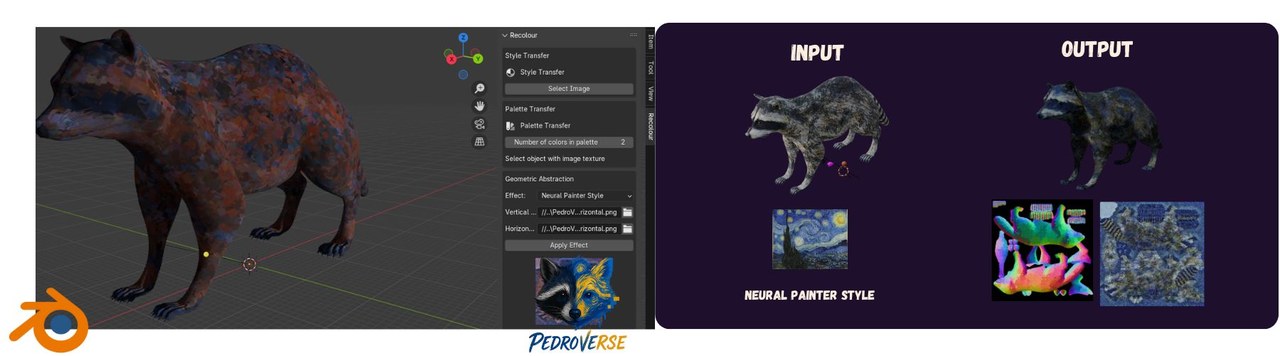
PedroVerse is a Blender add-on that turns hyper-realistic 3D assets into vibrant non-photorealistic (NPR) styles, without engine-specific shaders or external photo-editing tools. The trick: instead of touching geometry or writing shaders, we operate entirely on the asset’s UV maps (albedo and object-space normal maps), which almost every asset already ships with and which render cheaply everywhere. It was a team project for CMPT 461: Computational Photography at SFU.
The key insight
A shader built in Blender often can’t be exported to a game engine for rapid prototyping, and post-processing effects don’t generalize across engines or VR environments. But UV maps are universal. They carry strong visual priors, they’re inexpensive to render, and, crucially, the normal map preserves dynamic lighting even after stylization. So we define every stylization operation in UV space, combining classical image processing with lightweight deep learning into a modular, permutable pipeline.
The pipeline
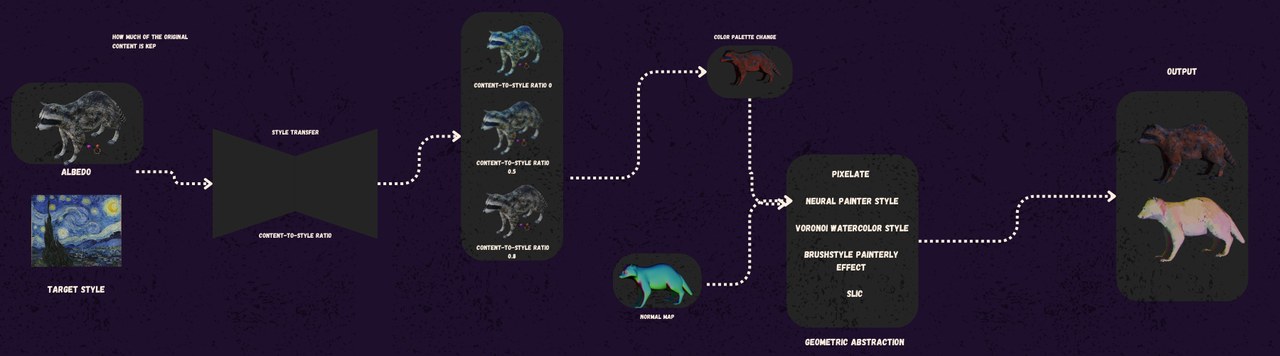
- Style transfer: a lightweight pretrained model encodes content and style images, then interpolates by a user-controlled content-to-style ratio (high-quality textures in ~2–3 s).
- Palette recoloring: palette-based photo recoloring with a modified k-means in LAB space; the artist edits the extracted palette through an HSV color picker.
- Geometric abstraction: five interchangeable structural filters spanning classical stroke-based rendering (Bézier brush strokes swept along image gradients), the neural Paint Transformer, SLIC superpixels, Pyxelate 8-bit pixelation, and an anime-style Voronoi watercolor effect.
The hard part is applying these to the normal map: a wrong color shift there changes the direction light bounces off the surface, producing artifacts. We found that gradient-aware methods (brush strokes) are far safer than noisy splatting (neural paint), that low SLIC compactness suppresses sudden curvature shifts, and that a bitwise mask between the stylized and original normal map keeps everything inside valid UV space.
Implementation & results
The UI is built on the Blender Python API; style transfer runs in TensorFlow, classical filters in OpenCV / scikit-image, and the Paint Transformer in PyTorch, with each component invoked via subprocess to dodge Blender’s module-import quirks, then packaged as a single add-on. Even the least-optimized method takes at most ~1 minute per asset.
Takeaways
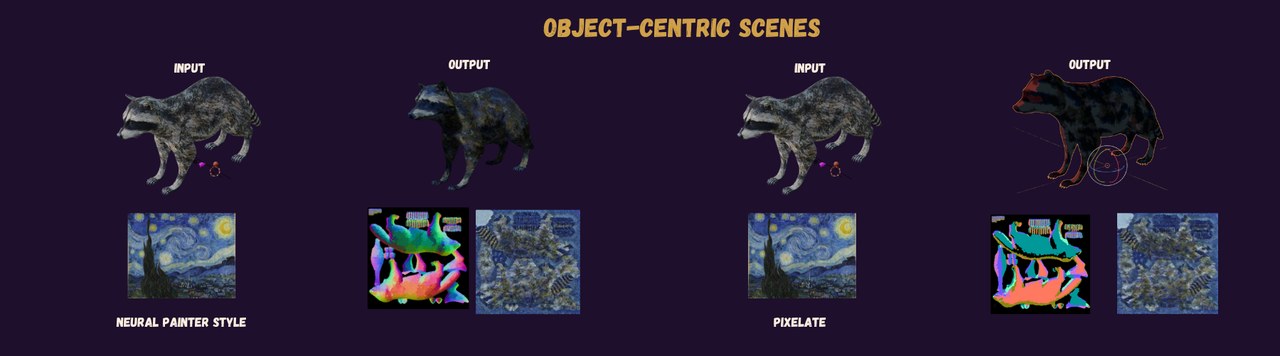
- Working in UV space buys portability for free. By never touching geometry or engine shaders, the same stylization travels across engines and VR: the whole reason the approach is worth it.
- Normal maps are unforgiving. Stylizing albedo is easy; stylizing the normal map without breaking lighting forced most of the interesting engineering (gradient-awareness, compactness tuning, UV masking).
- Classical + lightweight learning is a sweet spot for interactive tools: fast enough to keep an artist in the loop, flexible enough to permute many looks.
We’re also prototyping CLIP-based style transfer (CLIPstyler with ViT-B/32) to replace the VGG-based approach for text-driven stylization. Code is on GitHub.