At YITEC, as a Machine Learning Engineer (Oct 2020 – Jun 2021), I helped build Vietnam’s first real-time hand-tracking and AR ring try-on mobile app, letting customers try on jewellery rings from their phones instead of visiting a store. This was my first ML-engineering role, before I had any clue about AI research; it was pure, hands-on exploration, and it became one of the most formative projects of my early career.
The project was a major success, matching or beating the solutions of FPT and Viettel at the time, and laid the foundation for one of YITEC’s later core businesses.
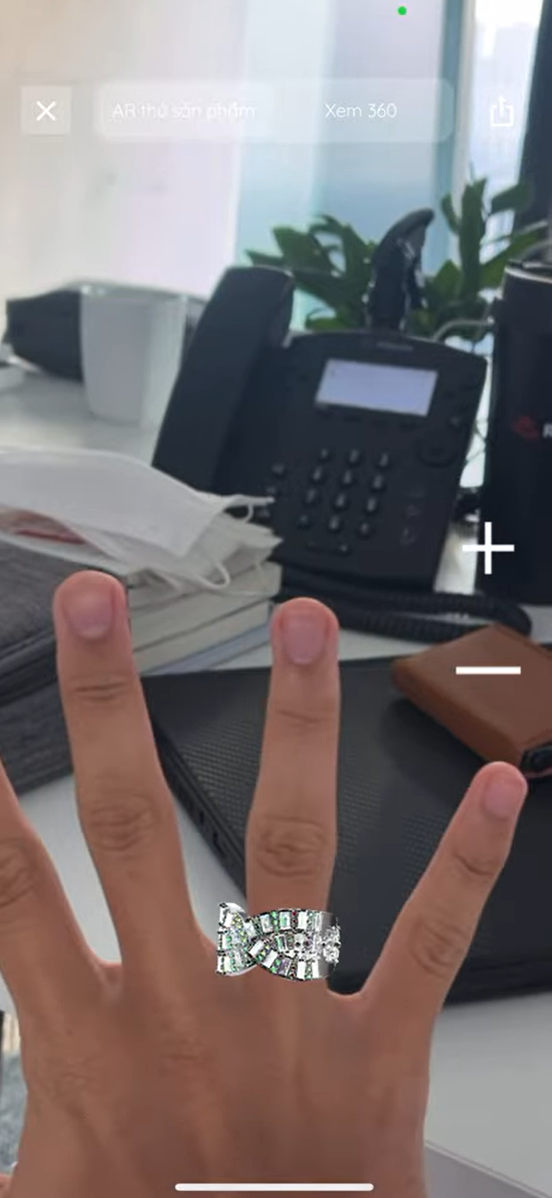
Demo
The engineering problem
Putting a convincing virtual ring on a moving finger in real time is a stack of hard sub-problems (tracking, rendering, lighting, and latency), all at once, on a phone. My work spanned:
- Hand tracking with MediaPipe Graph on Android Studio, including research into frame conversion and exporting to AAR format for integration with Unity.
- Real-time camera processing in Unity via AR Foundation, and using Google ARCore to read the scene’s lighting cues so the virtual ring and its reflection probe render under the same conditions as the real hand.
- Placement maths: deriving formulas for the ring’s position, scale, and rotation from MediaPipe’s relative landmark positions, plus an acceptable range for those factors that accounts for latency and vibration.
- Porting the MediaPipe API to C#, one call at a time, and attempting to integrate it with Unity Barracuda to eliminate frame conversion and cut latency.
- Stabilisation & denoising: experimenting with video-stabilisation and vibration-denoising algorithms that took the experience from 5 FPS to 30 FPS.
Takeaways
- Real-time AR is a latency budget first, an ML problem second. The biggest single win (5 → 30 FPS) came from stabilisation and removing frame conversions, not from a better model.
- Physical realism sells the illusion. Matching the ring’s lighting and reflections to ARCore’s scene cues mattered more to perceived quality than landmark precision.
- This was my on-ramp to ML. Approaching the field as an engineer first, shipping something real under hard constraints, shaped how I think about research today.
The most recent version of this work is under NDA, so the public repository reflects the earlier exploration. See also the YITEC project page and JLM.